Knowing When to Speak, When to Ask, and When to Stay Silent
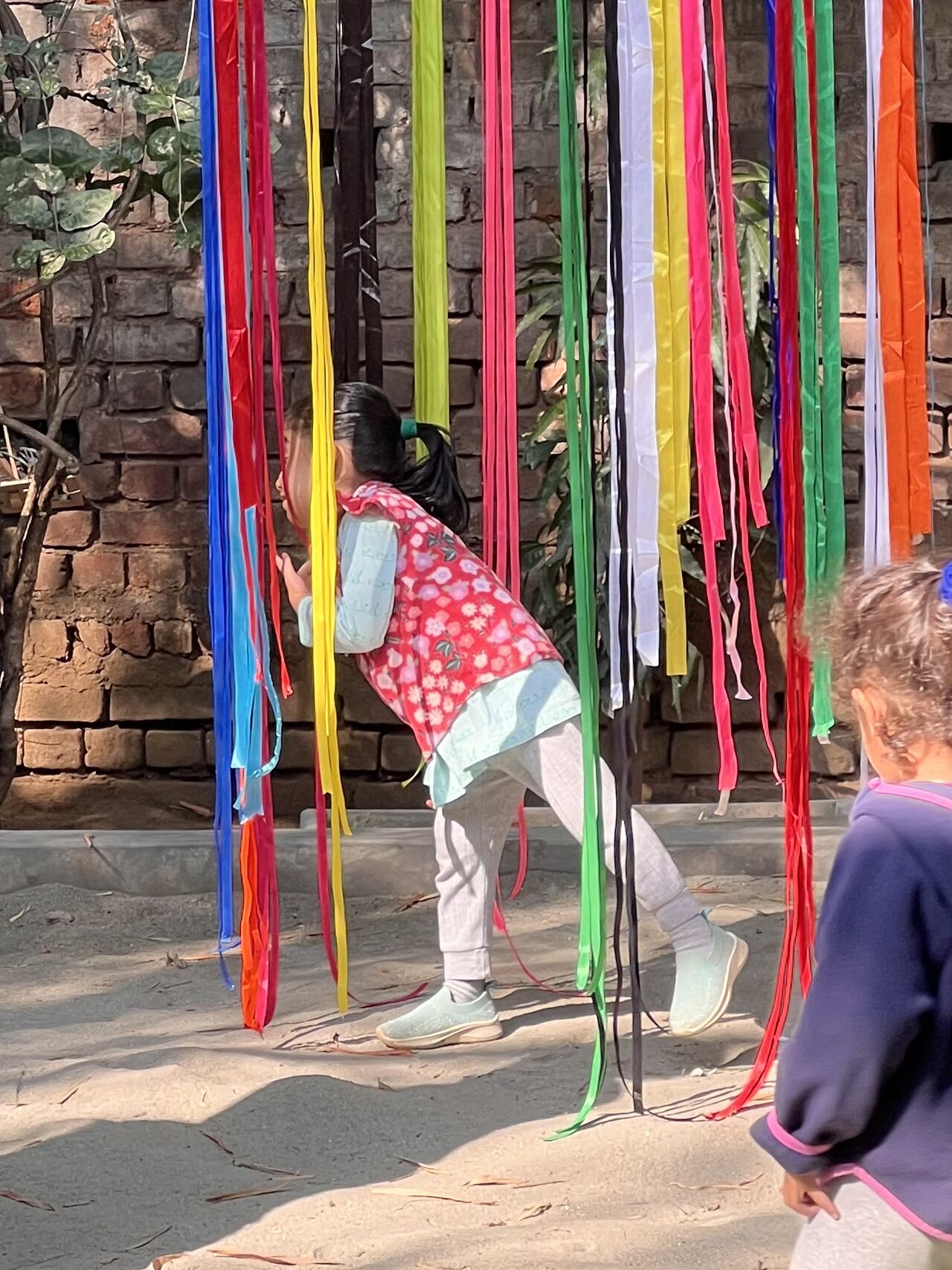
I was watching a child the other day, sitting quietly beneath a hula hoop suspended from a tree. Strips of satin ribbon hung from it, casting shifting shadows onto the sand. She had been part of our conversations on light, shadow, color, and movement—but at that moment, she wasn’t talking, she wasn’t “doing” in the way adults expect.
She was simply watching. Thinking. Processing.
And I stood there, resisting the urge to interrupt.
Because I knew the questions that could so easily come—
- “What color ribbons do you see?”
- “Do you see the shadow? Remember, we talked about shadows?”
It would have been easy to turn this into a “teaching moment”—to seek proof that learning was happening.
But thinking doesn’t always need an audience.
The real work of learning was happening—not in my voice, but in her silence.
The Assumption That Learning Must Be Loud
We assume a high-quality preschool environment is one filled with activity, noise, and verbal participation.
We associate learning with talking, answering, and movement. We assume that silence means disengagement, that a quiet child needs a push—“Go play! Join your friends!”
And yet, we would never interrupt a scientist deep in thought, staring at their work.
But we do this to children all the time.
Why?
Is it because we don’t recognize what a child is capable of? Is it because we assume learning must always be external, always visible?
Yet in many preschools in Gurgaon, there is pressure to fill every quiet moment, to always have an activity planned, a lesson delivered, a result seen.

Knowing When to Provoke and When to Pause
Yes, provocation is valuable. The right question can spark deeper inquiry, challenge assumptions, invite discovery.
But knowing when to ask is just as important as knowing when to be silent.
- Sometimes, a child isn’t ready to answer yet—because they’re still thinking.
- Sometimes, a child doesn’t need your voice—they need the space to hear their own.
- Sometimes, the best response is no response at all.
So the next time you see a child deep in thought, ask yourself— “Am I speaking for their benefit, or for mine?”
Because if we truly want to respect childhood, we must also learn to respect a child’s silence.
Explore Play-Based Learning at Tinker Lab